Buy izdirectory.com ?
We are moving the project
izdirectory.com .
Are you interested in purchasing the domain
izdirectory.com ?
domain@kv-gmbh.de · 0541-91531010
Buy izdirectory.com ?
What are notes in the bass clef?
Notes in the bass clef are the lower-pitched notes on the musical staff, typically played by instruments such as the cello, bass guitar, and left hand of the piano. The notes in the bass clef are represented by different symbols on the staff, with each symbol corresponding to a specific pitch. These notes provide the foundation and support for the overall harmony and rhythm of the music being played. Understanding and reading notes in the bass clef is essential for musicians who play instruments that utilize this clef. **
Where can I find bass notes for worship songs?
You can find bass notes for worship songs in a variety of places. Many worship songbooks and hymnals include bass notation for the songs they contain. Additionally, there are websites and apps that provide chord charts and sheet music for worship songs, which often include bass notes. You can also find instructional videos and tutorials online that demonstrate how to play the bass parts for specific worship songs. Lastly, if you are part of a worship team or church band, your music director or fellow musicians may be able to provide you with the bass notes for the songs you are playing. **
Similar search terms for Bass Notes
Top-Angebote
Products related to Bass Notes:
-
"""Bass Phillip""" """Bass Phillip Estate Pinot Noir 2019 Red Wine - Australia""""""The first sniff reveals a bowl of bright, fresh red berry fruit aromas, with delightful purity. With additional time in the glass, some deeper vinous characters appear. A seamless poised palate lined with refined tannins on a silky textural..."95,99 $*Shipping: 0,00 $Secure redirect to the provider
-
"""Bass Phillip""" """Bass Phillip Since 1979 Pinot Noir 2021 Red Wine - Australia""""""Fruit-driven aromas of mainly red berry fruits like raspberry, a dash of rhubarb, and cranberry. Pure, unadulterated Pinot Noir. A silky delicate palate with sweet berry flavors filling the middle palate with a soft, rounded structure; at once..."66,99 $*Shipping: 0,00 $Secure redirect to the provider
-
Fender Precision Bass Black 1978 Vintage Electric Bass Guitar Vintage Black - RefurbishedThis is a Fender Precision Bass in Black finish. The Fender Precision bass was launched in 1951, and despite how ubiquitous it is today, actually took a few years to catch on. Electric bass guitars were a new concept at the time, and Leo Fender had to travel to jazz clubs & concert halls to promote his new instrument face to face with musicians. Several design modifications were made throughout the '50s before a major revision in '57. The headstock was changed to resemble the Stratocaster rather than the Telecaster it had originally, and the pickguard was also changed to echo the design of the Strat. The iconic split single-coil pickup was added and the bridge was changed to a top-loading design with four steel saddles. Aside from offering Rosewood fingerboard & different pickup options in the following years, the P Bass' design has remained largely unchanged since 1957, and has gone down in history as the first commercially successful bass guitar design, with an immeasurable impact in the world of music. Made in the USA in 1978, this bass comes from the height of Fender's CBS era. Whilst CBS made several small design tweaks to Fender's instruments, the P Bass remained largely unchanged save for the use of a polyurethane finish. It is clear that this particular example has stood the test of time, and has been well played & enjoyed throughout its 47 year life. Naturally, a bolt-on construction is employed and comprises an Alder body, Maple neck and 20 fret Maple fingerboard. Chrome hardware is fitted including a top-loading bridge & split-post open-geared tuning machines. A split single-coil pickup is installed and wired to master volume & tone controls. The Maple neck plays very well, with a profile which might be described as a smooth and even 'C' shape, perhaps slightly thicker than you might find on Fender's modern offerings. Paired with the 7.25" fingerboard radius, this bass has a genuinely vintage specification. Along with the finish wear from the years of playing this bass has seen, the instrument feels very inspiring in the hands. Certainly, this bass has a 'mojo' to it which is often imitated on modern instruments but never equalled. Deep, rumbling lows will fill out your mix, whilst punchy mids and a sparkly top end will ensure that you have plenty of snap and attack to provide a lively and percussive performance. pushing your bass playing forward in the mix to create more urgency in the sound. The controls keep things simple; not intruding on the playing experience but still offering ample opportunities for tone shaping. Rolling the tone control down darkens the sound nicely, allowing you to blend more easily into the mix for a more mellow, quite jazzy tone. A well-loved bass that has worked hard throughout it's life but still has plenty to give.1890,00 £*Shipping: 0,00 £Secure redirect to the provider
-
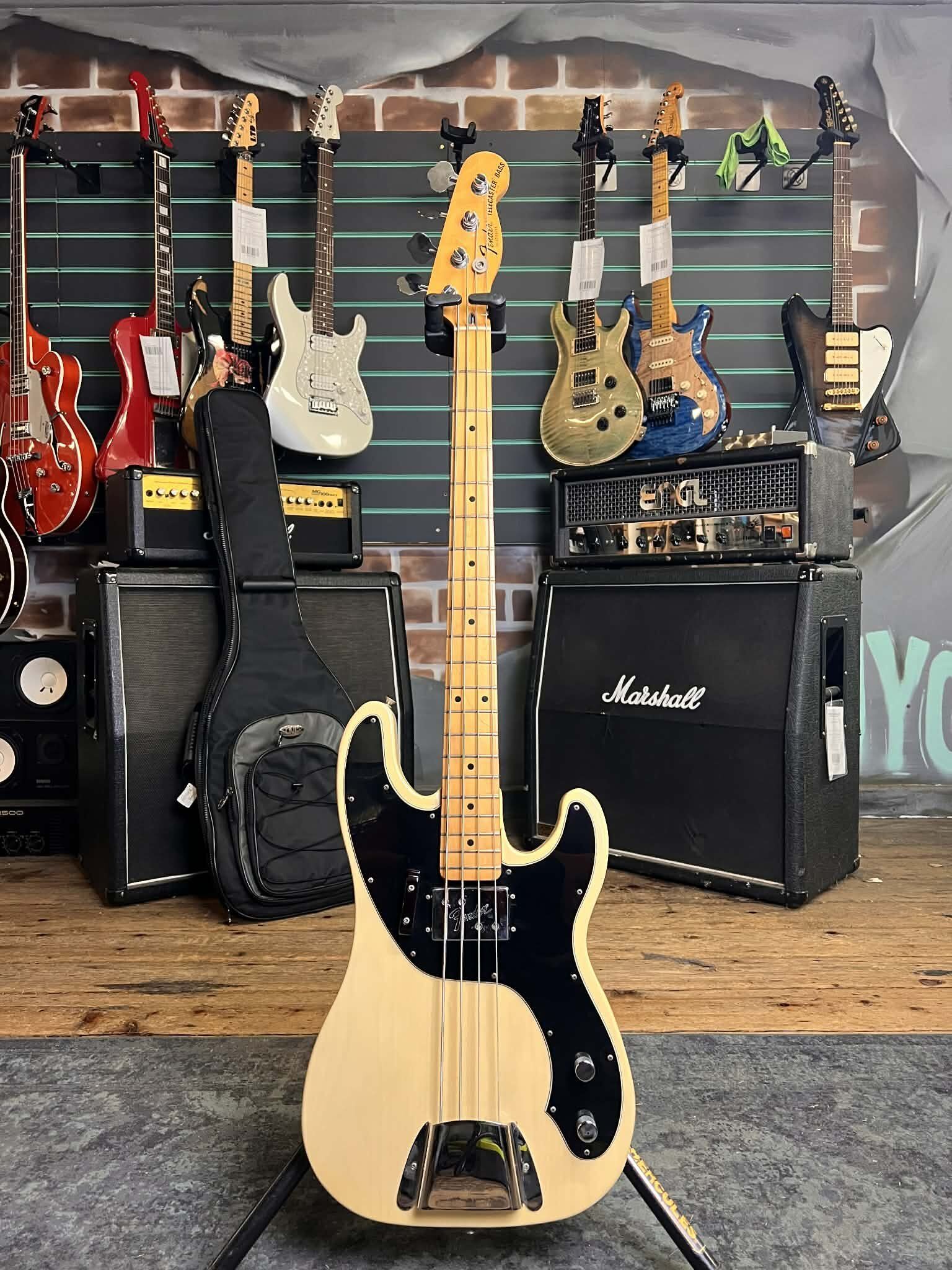
Fender Telecaster Bass Blonde 1977 Vintage Electric Bass Guitar Vintage Blonde - RefurbishedThis is a Fender Telecaster Bass in Blonde finish. Made in the USA in 1977, this bass comes from the second run of Telecaster Basses which were available from '71 up to their discontinuation in 1979. The original version was introduced in 1968, and was largely a reissue of the original Precision Bass, featuring Telecaster inspired features such as the small headstock, solitary single-coil pickup and separate control plate. In 1971 the design was updated to include some of the well-known CBS era appointments including the bullet truss rod nut and 3-bolt micro-tilt neck plate. Additionally the pickguard was re-designed to incorporate the controls and Fender's new Seth Lover-designed Wide Range pickup. The model was discontinued in '79, but has enjoyed several subsequent reissues as part of the Squier Vintage Modified series & Fender's Vintera II lineup. Naturally, a bolt-on construction is employed, and comprises an Ash body, Maple neck and 20 fret Maple fingerboard. Chrome hardware is fitted including a top-loading 4-saddle bridge with cover and Fender open-geared tuning machines. A Fender Wide Range Bass humbucking pickup is installed on the 3-ply black/white/black pickguard, and is wired to master volume & tone controls. The Maple neck plays very comfortably, with what might be described as a ‘U’ profile. This fillsthe hand reassuringly whilst still allowing for comfortable reach in all registers and promoting ergonomic thumb positioning. The double cutaway body design offers extended access into the upper register which works well with the gloss finish to the rear of the neck, allowing for smooth navigation of the 34” scale. The frets are on the larger size, feeling similar to modern medium jumbos. These feel great under the fingers, and provide the versatility required for a wide range of playing styles and techniques. The Wide Range Bass humbucker installed in this guitar had only been introduced in 1971, so the Telecaster bass was one of the first instruments to feature the pickup as factory standard. The Wide Range Bass humbucker makes use of 4 magnetised pole pieces rather than the bar magnet and screw arrangement of the Gibson PAF. Due to the difficulty of machining AlNiCo (Aluminium/Nickel/Cobalt) into threaded rod magnets, Fender chose to use CuNiFe magnets (Copper/Nickel/Iron) instead. As they produce less output than AlNiCo magnets, more windings were needed to produce enough output- resulting in a much larger enclosure than a typical humbucker. The tone is full-bodied and warm, filling out the bottom of the mix very nicely whilst still capturing all the snap and attack of your playing. A seriously cool instrument in astonishing condition. This is because between ‘77 and ‘78 Fender switched from using a string-thru bridge, to a top loading bridge. This means the body of the bass does not have holes and ferrules for a string-thru bridge. Please see the pictures of the body and neck attached to the listing. Luthier Report Our ID:...2470,00 £*Shipping: 0,00 £Secure redirect to the provider


-
How do I translate the bass notes for the accordion?
To translate the bass notes for the accordion, you will need to understand the layout of the bass buttons on the instrument. The bass side of the accordion typically has rows of buttons, each representing a different bass note or chord. The buttons are usually arranged in a specific pattern, with different rows representing different octaves or chord types. To translate the bass notes, you will need to learn the layout and corresponding notes of the buttons, and then practice playing the bass notes in conjunction with the melody on the keyboard side of the accordion. **
-
How do I transpose notes in the bass clef down 2 octaves?
To transpose notes in the bass clef down 2 octaves, you would simply subtract 24 from the original note's MIDI number. This will move the note down 2 octaves. For example, if the original note is C3 (MIDI number 48), subtracting 24 would give you C1 (MIDI number 24). This new note is 2 octaves lower than the original note. **
-
How can one transcribe the notes from the bass clef to the treble clef?
To transcribe notes from the bass clef to the treble clef, you need to move the notes up by one octave. For example, if a note is on the third line of the bass clef, it would be moved up to the third space of the treble clef. Additionally, you may need to adjust the key signature and accidentals to ensure the notes are correctly transcribed. It's important to pay attention to the range of the instrument or voice you are transcribing for, as notes may need to be adjusted further to fit within the appropriate range. **
-
How can you rewrite the notes from the bass clef to the treble clef?
To rewrite notes from the bass clef to the treble clef, you need to move the notes up one octave. This means that if a note is on a line in the bass clef, you would rewrite it on the space directly above in the treble clef. If the note is on a space in the bass clef, you would rewrite it on the line directly below in the treble clef. It's important to remember that the relationship between the notes remains the same, just their placement on the staff changes. **

How are the bass notes converted into triads? Are there specific rules to follow?
Bass notes are converted into triads by adding two additional notes to create a three-note chord. The specific rules to follow depend on the musical context and the desired harmonic progression. In general, the most common method is to add the third and fifth notes of the scale above the bass note to form a triad. However, there are also variations and substitutions that can be used to create different harmonic colors and textures. Ultimately, the conversion of bass notes into triads is a creative process that can be approached in various ways depending on the musical style and context. **
How can you transcribe the notes from the bass clef to the treble clef?
To transcribe notes from the bass clef to the treble clef, you need to move the notes up by two lines or spaces. For example, if a note is on the second line of the bass clef, it would be moved to the fourth line of the treble clef. Additionally, you may need to adjust the octave of the notes to ensure they are within the appropriate range for the treble clef. It's important to remember that the key signature and any accidentals should also be taken into account when transcribing notes between clefs. **
Top-Angebote
Products related to Bass Notes:
-
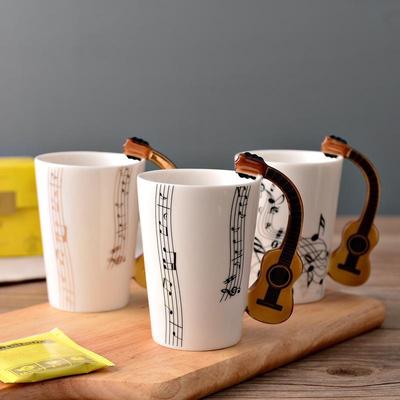
KitchenCuration Novelty Guitar Ceramic Mug Perfect Gift For Musicians Ceramic Guitar Cup With Musical Notes Red BassStart Your Day with Melody Guitar Coffee MugCoffee mugs are indispensable in our livesthey help us kickstart our mornings, rejuvenate us during the day, and accompany us through memorable family evenings. Elevate your mug game with our Novelty...39,97 $*Shipping: 0,00 $Secure redirect to the provider
-
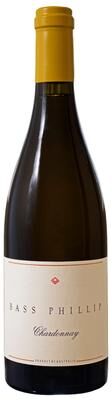
"""Bass Phillip""" """Bass Phillip Estate Chardonnay 2019 White Wine - Australia""""""A complex amalgam of nougat and almond takes your notice before a wave of white fruits steeped in a creamy vanilla sauce fills the nostrils. A wonderfully harmonious, supple, and lithe palate with everything in place - ready for a long and exciting..."70,99 $*Shipping: 0,00 $Secure redirect to the provider
-
"""Bass Phillip""" """Bass Phillip Estate Pinot Noir 2019 Red Wine - Australia""""""The first sniff reveals a bowl of bright, fresh red berry fruit aromas, with delightful purity. With additional time in the glass, some deeper vinous characters appear. A seamless poised palate lined with refined tannins on a silky textural..."95,99 $*Shipping: 0,00 $Secure redirect to the provider
-
"""Bass Phillip""" """Bass Phillip Since 1979 Pinot Noir 2021 Red Wine - Australia""""""Fruit-driven aromas of mainly red berry fruits like raspberry, a dash of rhubarb, and cranberry. Pure, unadulterated Pinot Noir. A silky delicate palate with sweet berry flavors filling the middle palate with a soft, rounded structure; at once..."66,99 $*Shipping: 0,00 $Secure redirect to the provider
-
What are notes in the bass clef?
Notes in the bass clef are the lower-pitched notes on the musical staff, typically played by instruments such as the cello, bass guitar, and left hand of the piano. The notes in the bass clef are represented by different symbols on the staff, with each symbol corresponding to a specific pitch. These notes provide the foundation and support for the overall harmony and rhythm of the music being played. Understanding and reading notes in the bass clef is essential for musicians who play instruments that utilize this clef. **
-
Where can I find bass notes for worship songs?
You can find bass notes for worship songs in a variety of places. Many worship songbooks and hymnals include bass notation for the songs they contain. Additionally, there are websites and apps that provide chord charts and sheet music for worship songs, which often include bass notes. You can also find instructional videos and tutorials online that demonstrate how to play the bass parts for specific worship songs. Lastly, if you are part of a worship team or church band, your music director or fellow musicians may be able to provide you with the bass notes for the songs you are playing. **
-
How do I translate the bass notes for the accordion?
To translate the bass notes for the accordion, you will need to understand the layout of the bass buttons on the instrument. The bass side of the accordion typically has rows of buttons, each representing a different bass note or chord. The buttons are usually arranged in a specific pattern, with different rows representing different octaves or chord types. To translate the bass notes, you will need to learn the layout and corresponding notes of the buttons, and then practice playing the bass notes in conjunction with the melody on the keyboard side of the accordion. **
-
How do I transpose notes in the bass clef down 2 octaves?
To transpose notes in the bass clef down 2 octaves, you would simply subtract 24 from the original note's MIDI number. This will move the note down 2 octaves. For example, if the original note is C3 (MIDI number 48), subtracting 24 would give you C1 (MIDI number 24). This new note is 2 octaves lower than the original note. **
Similar search terms for Bass Notes
-
Fender Precision Bass Black 1978 Vintage Electric Bass Guitar Vintage Black - RefurbishedThis is a Fender Precision Bass in Black finish. The Fender Precision bass was launched in 1951, and despite how ubiquitous it is today, actually took a few years to catch on. Electric bass guitars were a new concept at the time, and Leo Fender had to travel to jazz clubs & concert halls to promote his new instrument face to face with musicians. Several design modifications were made throughout the '50s before a major revision in '57. The headstock was changed to resemble the Stratocaster rather than the Telecaster it had originally, and the pickguard was also changed to echo the design of the Strat. The iconic split single-coil pickup was added and the bridge was changed to a top-loading design with four steel saddles. Aside from offering Rosewood fingerboard & different pickup options in the following years, the P Bass' design has remained largely unchanged since 1957, and has gone down in history as the first commercially successful bass guitar design, with an immeasurable impact in the world of music. Made in the USA in 1978, this bass comes from the height of Fender's CBS era. Whilst CBS made several small design tweaks to Fender's instruments, the P Bass remained largely unchanged save for the use of a polyurethane finish. It is clear that this particular example has stood the test of time, and has been well played & enjoyed throughout its 47 year life. Naturally, a bolt-on construction is employed and comprises an Alder body, Maple neck and 20 fret Maple fingerboard. Chrome hardware is fitted including a top-loading bridge & split-post open-geared tuning machines. A split single-coil pickup is installed and wired to master volume & tone controls. The Maple neck plays very well, with a profile which might be described as a smooth and even 'C' shape, perhaps slightly thicker than you might find on Fender's modern offerings. Paired with the 7.25" fingerboard radius, this bass has a genuinely vintage specification. Along with the finish wear from the years of playing this bass has seen, the instrument feels very inspiring in the hands. Certainly, this bass has a 'mojo' to it which is often imitated on modern instruments but never equalled. Deep, rumbling lows will fill out your mix, whilst punchy mids and a sparkly top end will ensure that you have plenty of snap and attack to provide a lively and percussive performance. pushing your bass playing forward in the mix to create more urgency in the sound. The controls keep things simple; not intruding on the playing experience but still offering ample opportunities for tone shaping. Rolling the tone control down darkens the sound nicely, allowing you to blend more easily into the mix for a more mellow, quite jazzy tone. A well-loved bass that has worked hard throughout it's life but still has plenty to give.1890,00 £*Shipping: 0,00 £Secure redirect to the provider
-
Fender Telecaster Bass Blonde 1977 Vintage Electric Bass Guitar Vintage Blonde - RefurbishedThis is a Fender Telecaster Bass in Blonde finish. Made in the USA in 1977, this bass comes from the second run of Telecaster Basses which were available from '71 up to their discontinuation in 1979. The original version was introduced in 1968, and was largely a reissue of the original Precision Bass, featuring Telecaster inspired features such as the small headstock, solitary single-coil pickup and separate control plate. In 1971 the design was updated to include some of the well-known CBS era appointments including the bullet truss rod nut and 3-bolt micro-tilt neck plate. Additionally the pickguard was re-designed to incorporate the controls and Fender's new Seth Lover-designed Wide Range pickup. The model was discontinued in '79, but has enjoyed several subsequent reissues as part of the Squier Vintage Modified series & Fender's Vintera II lineup. Naturally, a bolt-on construction is employed, and comprises an Ash body, Maple neck and 20 fret Maple fingerboard. Chrome hardware is fitted including a top-loading 4-saddle bridge with cover and Fender open-geared tuning machines. A Fender Wide Range Bass humbucking pickup is installed on the 3-ply black/white/black pickguard, and is wired to master volume & tone controls. The Maple neck plays very comfortably, with what might be described as a ‘U’ profile. This fillsthe hand reassuringly whilst still allowing for comfortable reach in all registers and promoting ergonomic thumb positioning. The double cutaway body design offers extended access into the upper register which works well with the gloss finish to the rear of the neck, allowing for smooth navigation of the 34” scale. The frets are on the larger size, feeling similar to modern medium jumbos. These feel great under the fingers, and provide the versatility required for a wide range of playing styles and techniques. The Wide Range Bass humbucker installed in this guitar had only been introduced in 1971, so the Telecaster bass was one of the first instruments to feature the pickup as factory standard. The Wide Range Bass humbucker makes use of 4 magnetised pole pieces rather than the bar magnet and screw arrangement of the Gibson PAF. Due to the difficulty of machining AlNiCo (Aluminium/Nickel/Cobalt) into threaded rod magnets, Fender chose to use CuNiFe magnets (Copper/Nickel/Iron) instead. As they produce less output than AlNiCo magnets, more windings were needed to produce enough output- resulting in a much larger enclosure than a typical humbucker. The tone is full-bodied and warm, filling out the bottom of the mix very nicely whilst still capturing all the snap and attack of your playing. A seriously cool instrument in astonishing condition. This is because between ‘77 and ‘78 Fender switched from using a string-thru bridge, to a top loading bridge. This means the body of the bass does not have holes and ferrules for a string-thru bridge. Please see the pictures of the body and neck attached to the listing. Luthier Report Our ID:...2470,00 £*Shipping: 0,00 £Secure redirect to the provider
-
"""Bass Phillip""" """Bass Phillip Premium Old Vines Pinot Noir 2019 Red Wine - Australia""""""Initially, the fruit and oak are tussling for attention, with ripe cherries and red plums eventually reaching ascendancy. Over time this amalgam will amplify the complexity and become a harmonious whole. The delicious savory and fruit flavors of..."255,99 $*Shipping: 0,00 $Secure redirect to the provider
-
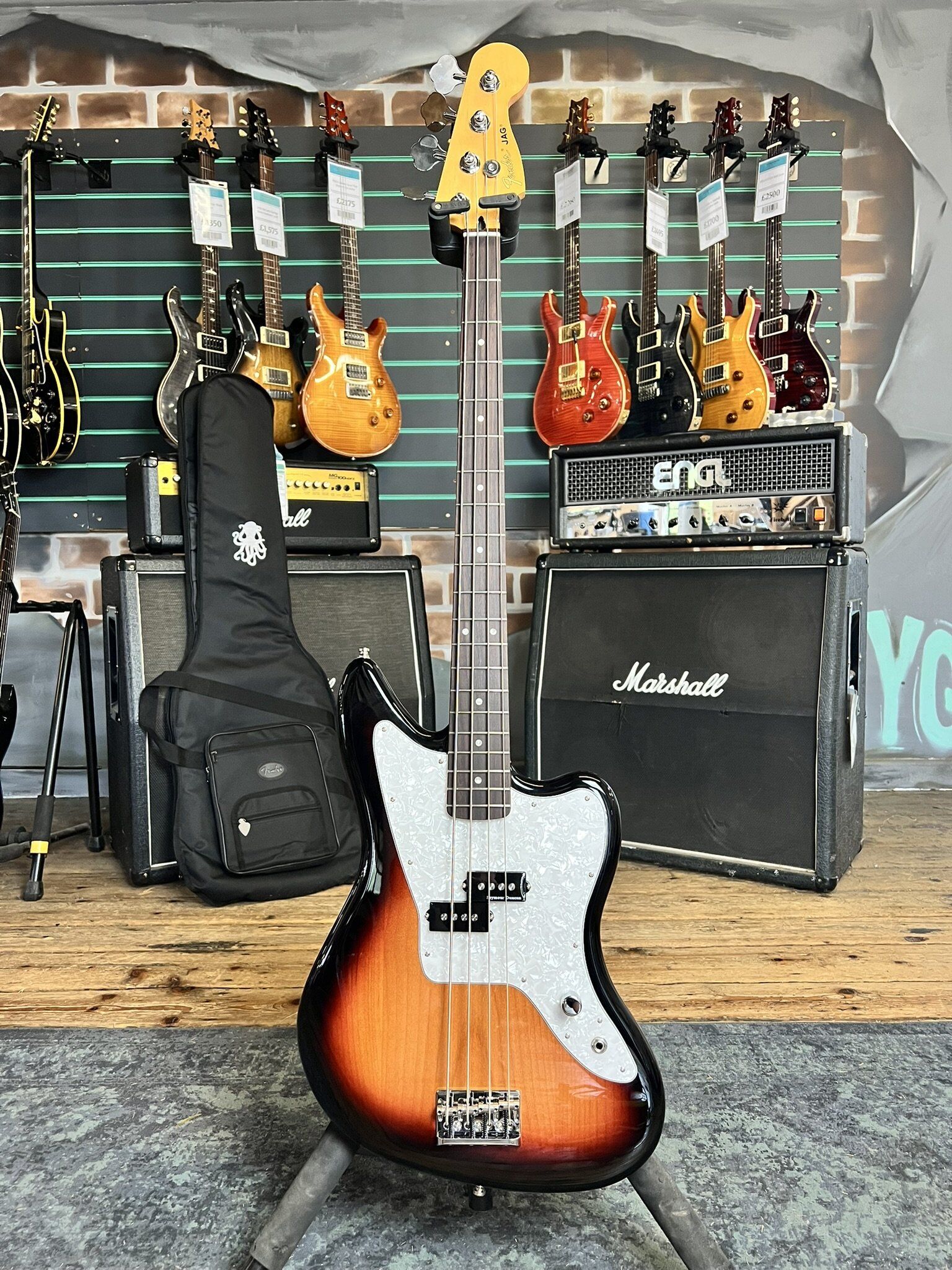
Fender Ltd Edition Mark Hoppus Jaguar Bass 3-Color Sunburst 2025 Electric Bass Sunburst - RefurbishedThis is a Limited Edition Mark Hoppus Jaguar Bass in 3-Color Sunburst finish. Made in Mexico in 2025, this guitar is the exact model that Mark Hoppus currently uses on stage with Blink-182. Mark's first signature bass was a Jazz bass with a Precision neck and pickup, and came into existence around 1999, first being seen in the video for 'Adam's Song'. In the early Blink days, Hoppus was seen to use Musicman Sting Ray, but gradually transitioned towards Fender around the time of 'Enema of the State'. The single pickup and control configuration is echoed on this new Jaguar signature model, which Mark has been using since Blink-182's recent reunion. A bolt-on construction is employed and comprises an Alder body, Maple neck and 20 fret Rosewood fingerboard. Nickel/Chrome hardware is fitted including a string-through-body or top-loading 4-Saddle HiMass Vintage bridge, Fender Lightweight Vintage-Style open-geared tuning machines and a Mark Hoppus laser-etched neck plate. A single Seymour Duncan Quarter Pound Precision Bass split-coil pickup is installed in the middle position, and is wired to a master volume control. The Maple neck plays very well, with a Custom 'C' profile derived in collaboration with Mark Hoppus. The distinctive carve feels comfortable in the hand and provides a smooth and precise playing experience without being too thin. The 9.5" radius provides a modern playing feel allowing the hand to glide effortlessly across the fingerboard. This combined with the slab rosewood fingerboard and satin finish to the rear of the neck makes for a luxurious playing experience. The Seymour Duncan Quarter Pound P Bass pickup provides a fat, punchy tone as soon as you plug this bass in. A tremendous mid-range presence is well complemented by the rich, full low end, with a fast attack and treble response that keeps your bass right in the sweet-spot of the mix. The simple controls of a single master volume make this bass incredibly easy to dial in, making it a real plug and play experience. This is a bass perfect for the pop-punk & rock tones Blink-182 and Hoppus are famous for. Luthier Report Our ID: 1190726224650 Weight: 8.9lbs Serial: MX24111401 Aesthetic Condition: Headstock: Overall excellent condition. All aspects of the headstock display light signs of past use. Neck: Overall excellent condition. All aspects of the neck and fingerboard display light signs of past use. Body: Overall excellent condition. All aspects of the body display light signs of past use. Condition of Frets: The frets demonstrate very light signs of use, not affecting playability. There is considerable material remaining for any fret work the new owner may wish to perform. Current Set Up: Truss Rod: Fully functional. Truss rod tool (3/16" hex) included. Hardware: Excellent condition. Structural: No concerns or issues to note. Height of the string from the 12th Fret-2mm - Bass 2.25mm Please be aware that the action on a guitar may move slightly in transit and this measurement...970,00 £*Shipping: 0,00 £Secure redirect to the provider
-
How can one transcribe the notes from the bass clef to the treble clef?
To transcribe notes from the bass clef to the treble clef, you need to move the notes up by one octave. For example, if a note is on the third line of the bass clef, it would be moved up to the third space of the treble clef. Additionally, you may need to adjust the key signature and accidentals to ensure the notes are correctly transcribed. It's important to pay attention to the range of the instrument or voice you are transcribing for, as notes may need to be adjusted further to fit within the appropriate range. **
-
How can you rewrite the notes from the bass clef to the treble clef?
To rewrite notes from the bass clef to the treble clef, you need to move the notes up one octave. This means that if a note is on a line in the bass clef, you would rewrite it on the space directly above in the treble clef. If the note is on a space in the bass clef, you would rewrite it on the line directly below in the treble clef. It's important to remember that the relationship between the notes remains the same, just their placement on the staff changes. **
-
How are the bass notes converted into triads? Are there specific rules to follow?
Bass notes are converted into triads by adding two additional notes to create a three-note chord. The specific rules to follow depend on the musical context and the desired harmonic progression. In general, the most common method is to add the third and fifth notes of the scale above the bass note to form a triad. However, there are also variations and substitutions that can be used to create different harmonic colors and textures. Ultimately, the conversion of bass notes into triads is a creative process that can be approached in various ways depending on the musical style and context. **
-
How can you transcribe the notes from the bass clef to the treble clef?
To transcribe notes from the bass clef to the treble clef, you need to move the notes up by two lines or spaces. For example, if a note is on the second line of the bass clef, it would be moved to the fourth line of the treble clef. Additionally, you may need to adjust the octave of the notes to ensure they are within the appropriate range for the treble clef. It's important to remember that the key signature and any accidentals should also be taken into account when transcribing notes between clefs. **
* All prices are inclusive of VAT and, if applicable, plus shipping costs. The offer information is based on the details provided by the respective shop and is updated through automated processes. Real-time updates do not occur, so deviations can occur in individual cases. ** Note: Parts of this content were created by AI.